I am passionate towards new things; the ‘out of the box’ ideas. This time I am on a mission to create opportunities. Opportunities for my fellow dentist all over India.
Now a days we have many negative stories of dentist changing profession because of lack of scope. But I strongly believe that there is immense scope in dentistry.
Dental clinic is a team work where a principle dentist needs associate dentist as well as specialist for specific case. There is a lot of existing opportunity. The need of an hour is to organise this sector of jobs and consultation in dentistry.
Coming back to my story, I am Dr Nomal Sheth, MDS in Endodontics and Conservative dentistry. One day I was sitting idle and thinking about my last few years, ‘how I struggled to get consultation in a new place after marriage’. I was just wondering how I moved from one clinic to another in 2014 with my visiting card so as to get consultations. The flow of my thoughts started taking a bigger picture and I was thinking that this might be a story of every specialist. Also I started my first clinic in 2008 in Nagpur when I was just a fresher and I didn’t know anyone when I wanted a specialist for my clinic. So I started looking at both sides of the coin. As a specialist you don’t know which clinician is looking for consultant in your location. On the other side of coin, clinician doesn’t know which specialists are available in their area. This made me think that it would be so easy if there is a directory with names of all available specialists in specific location. I thought to create such booklet and provide it to all dentist I know. Now the question was that how to do it. I have my start-up in an incubator in Mumbai. So I decided to share my idea with those start-up guys. They advised me that I should first find the scope of the idea and find out whether there is a need for such diary! Secondly they said that it’s a digital world, and a booklet would not work here. I should create a search engine where anyone can search specialist from any location all over India. So I decided to undergo a survey asking about the need for such website. Surprisingly I got an overwhelming response and people were eager to use such platform. Then I took help from the incubator and designed a website by the name dentaljoint.com
Being a dentist I had no idea about IT and website designing. So I created a team from my incubator. Those were Engineers and IT Students. I used to sit for hours with them to know insight of website and search engine designing. I did content writing for the website rather that appointing a content writer because it’s my baby so I can explain it the best. After all these efforts I came up with the website www.dentaljoint.com launched on 28th February 2019
Dental Joint is on a mission to connect clinicians with consultants so as to create job opportunities for specialist all over India. Currently popular way to find a consultant is either social media or through word of mouth. Dental Joint is a combination of both.
Dental Joint provides the profile of consultants as per the specialty and location. These profiles have features like contact details, experience, testimonial and rating of the specialist. Based on these one can decide the appropriate consultant. In this way clinician can save their time and efforts.
Currently Dental Joint has 255 enrolled specialists from 46 cities all over India and 7,541 users in one year.
My vision is to create maximum work opportunities for general as well as specialist dentist by listing them online. Also currently I am working on ground level to make this platform available for graduate dentist who are looking for work opportunity as visiting or job as associate dentist.
My passion is on mission to make a difference in the world ‘I live’. Let us see where my passion takes me and how far I can help others achieve their goals.
Want to publish your article or other content on D1 Magazine ?
Get a FREE Membership on Sign Up and Go to Articles in your Profile Page. Become an Author Dentista.
A general dentist is mostly concerned with the study, diagnosis, prevention and treatment of the most common oral diseases which are dental caries and periodontal disease. Various treatment modalities involve the restoration of teeth, extraction or surgical removal of teeth, scaling and root planing,root canal treatment and replacement of missing tooth/teeth. However, a few challenging cases are reported leading to dilemma in diagnosis, treatment choice and the ultimate outcome.
The epidemic of caries and untreated periodontal diseases led to a concomitant increase in the extraction of teeth by dentists.A general dentist comes across cases of replacement of missing teeth on a regular basis.It can be challenging to decide the treatment plan in such a scenario due to the several options available (Figure 1). Replacement of the teeth in edentulous arches is recommended because when tooth loss occurs, masticatory function is diminished; when the underlying bone of the jaws is not under normal function it can slowly lose its mass and density, which can lead to fractures of mandible and reduction of the vertical dimension of the face. The physical appearance of the person is also noticeably affected.
Using
conventional method, the missing teeth can be replaced by using tooth or tissue
supported prostheses. These include complete dentures for replacement of fully
edentulous arches and conventional bridges or removable or fixed partial
dentures for replacement of partially edentulous arches. An alternative method
of replacement is the bone supported prostheses – dental implants (Figure 2).
Dental implant or fixture is defined by the Oxford Dental
Dictionary as “a device specifically designed to be placed surgically within or
on the mandibular or maxillary bone as a means of providing retention for a
prosthetic replacement of one or more teeth”. Over the last several years, many
different types of implants have been invented, improving the quality and lives
of many people suffering from dentition loss.
An implant can be used to support a single crown or a bridge or even to retain complete dentures.An endodontic implant can be used to provide increased retention and decrease tooth mobility.Many of the patients that a dentist encounters have insufficient dental support suitable for orthodontic anchorage or are not compliant with wearing extra-oral devices. Orthodontic implants have become broadly accepted as alternatives to extra-oral devices in such patients. Mini implants (orthodontic implants) are used in orthodontics as temporary anchorage devices.The many advantages of using mini-implants include ease of insertion, increased patient comfort, immediate loading and low price.
Implants are becoming the treatment of choice for a number of reasons. Most significant among these is the expected longevity, strength and stability offered by current implant treatment, as well as the predictability of implant treatment with current technologies. Today’s dental implants are strong, durable, and virtually indistinguishable from natural teeth and are typically placed in a single sitting. They offer long-term solution to tooth loss. In the presence of healthy tissues, a well-integrated implant with appropriate biochemical loads can have long term success rates of 93% to 98% for the fixture and 10 to 15 years life span for the prosthetic tooth. Implants are less dependent than tooth or tissue supported prostheses on the configuration of remaining natural teeth in the arch. They can be used to support prostheses for a completely edentulous arch, for an arch devoid of posterior tooth support and for almost any configuration of partial edentulism with tooth support on both sides of the edentulous space (Figure 3). The patient’s function when wearing a denture may be reduced to one sixth of that level formerly experienced with natural dentition; however an implant prostheses may return the function to near-normal limits. As implants are more successful and result in fewer complications, they develop a competitive advantage among the technical alternatives. In traditional dentistry the restoration reflects the existing condition of the patient. The dentist evaluates existing natural abutments first and fabricates a removable or fixed restoration accordingly. Treatment using implants is unique because additional foundation units may be created for a desired prosthodontic result.
General
dentists around the world certainly have proven that it is well within the
capability of every general practitioner to be able to surgically place dental
implants. However, a large group of general dentists hesitate in doing this
surgical procedure for various reasons. These include:-
The surgical procedure is technique sensitive
Need to undergo special training for performing the
procedure
Expensive
equipments
Confusion
due to the various different types of implant systems available
Experience
plays a vital role in the success of implant treatment
There
may be a need to do bone grafting at the time of implant placement or before
implant placement which is again technique sensitive
Risks
associated with dental implants are higher compared to the alternative
treatment options
It
is harder to manage the complications associated with dental implants.
However, because of the awareness of implant treatment and patient needs, a majority of dental professionals have equipped themselves with the requirements of implant procedures and have gained knowledge about failures and associated complications.
Factors that affect the need and demand for dental implants can be described under macro-factors and individual factors.
Macro-factors include:-
Overall population growth
Growth in disposable per capita income
Improvement in education levels
Extent and severity of oral disease that can result in loss of teeth
Tooth loss itself
Individual factors include:-
General health of the patient and any contraindications for the surgical implant procedure
Configuration of the remaining teeth in the arch as well as the opposing arch
Number of tooth spaces that need replacement by prostheses
The preference of the patient and his or her willingness to undergo a more invasive surgical procedure required by the dental implant option
Relative cost of the implant option compared to the alternative
Although they demonstrate a very high success rate, oral implants may fail for a number of reasons, often related to a failure in the osseointegration process. If the implant is placed in a poor position, osseointegration may not take place. Like natural teeth, dental implants may break or become infected and crowns may become loose. Dental implants are not susceptible to caries attack, but poor oral hygiene can lead to development of Peri-implantitis around the dental implant. Peri-implantitisis one of the common complications and leads to bone loss and implant failure (Figure 4).
A general practitioner should be able to manage a case of implant failure. Implants undergoing early or late failure show progressive bone loss and can be readily diagnosed on radiographs. Clinically, signs of infection such as the presence of fistula in the soft tissue covering the implants, purulent discharge on exploration, bleeding, discoloration of marginal gingival tissue, and discomfort to probing at the implant site may also be present. If left untreated, bone loss typically continues and, with time, complete loss of osseointegration will occur. The approach to treatment of ailing implants is often empirical and is an extension of modalities of treatment of periodontitis that occurs around the natural dentition. The goal is therefore to stop further bone loss and establish a healthy peri-implant soft tissue interface.Peri-implantitis can sometimes be treated, but in most cases the implant must be removed.In the case of a loose dental implant, the only treatment is to immediately remove all components of the implant to avoid the progressive destruction of the surrounding tissues.After a careful investigation of the clinical situation, the general practitioner must decide whether to carry out the implant removal or refer the patient to a specialist.All is not lost if a dental implant fails. It is sometimes possible to save an implant by building up the bone &gingival tissue surrounding it. However, in most cases the implant must often be removed and the area left to heal. Re-implantation procedure can be attempted once the area has recovered, which can take up to a year or until the dentist determines that the site is suitable. Depending on how well the area heals, a bone graft might be required to provide a better foundation for the implant and improve the chance of success.Scaling of dental implants is done using special instruments like plastic hand scalers, graphite and titanium hand scalers, ultrasonic scalers with titanium coated tips.
A
general dentist considering the use of implants should be well versed with its
contraindications as well. These include,
Systemic
contraindications:-
Severe
blood diseases
Within
six months of an attack of myocardial infarction
Cerebral
infarction and cerebral apoplexy
Severe
immunodeficiency
Chemotherapy
patients
Neuropsychiatric
patients
Youth
under the age of 15
Severe
osteoporosis
Local
contraindications:-
Insufficient
bone quantity, but where bone augmentation procedures with bone graft is not
possible.
Severe
periodontal diseases
Intractable
periodontitis
High
exposure to radiation
Chronic
osteomyelitis
Bruxism
Mouth
closing disorders
Heavy
smokers
Sjögren’s syndrome
Poor oral hygiene
It can be an easy or difficult decision to remove a tooth and place an
implant. Patients should also be involved in making that decision. Thorough
informed consent should be provided, and a detailed discussion of the potential
for success or failure should be made. The joint patient-dentist decision
should be based on the amount of tooth structure remaining, occlusion,
financial considerations, patient desire to keep the natural tooth, and patient
acceptance of other needed procedures to retain the tooth. Clinical procedure
can be successful if all factors are considered and treatment is accomplished
properly (Figure 5).
During the past several years, great strides have been made
in dental practices. With the advent of newer materials, newer techniques and a
better understanding of the dental anatomy, dentistry has achieved newer
levels. Dentistry has evolved over the years to bring to its patient’s better
treatment options and restorative and prosthetic solutions which have higher
success ratio and survival rates.
As new implant surface technologies develop and prosthetic options increase, the field of dental implantology continues to change. Implants are the nearest equivalent replacement to the natural tooth, and are therefore a useful addition in the management of patients who have missing teeth because of caries, periodontal diseases, trauma or developmental anomalies. General dentists considering the use of this treatment modality should be aware of the importance of treatment planning, assessment and teamwork in achieving successful outcomes and should gain the skills, education, and technology to add implants to their practice.
Want to publish your article or other content on D1 Magazine ?
Get a FREE Membership on Sign Up and Go to Articles in your Profile Page. Become an Author Dentista.
Root= Just like the trees have their roots, a tooth also has its roots attached to the bone.These roots help to hold the tooth in its place.
2. Canal= A root consists of canals from where the treatment is started and is continued.
3. Treatment= We all know what is treatment, so I think I should now discuss further regarding RCT.
DEFINITION:
Root Canal Treatment/Therapy(RCT) can be defined as a dental treatment for removing infection(infected pulp) from inside a tooth.The best thing is that it can also protect the tooth from future infections.
What is the correct time to undergo this treatment.
Lets see:
Prolonged sensitivity/pain on taking hot or cold drinks/meals and does not get relieved even after you stop taking it.
Severe toothache/pain upon chewing something.
Discoloration/blackening of the tooth.
Swelling and tenderness in the nearby gums.
What happens when you delay your RCT treatment?
1.The infection continues to grow like a fire.
2.Bacteria from the infected tooth pulp can reach into the tissue of the gums and jaw.
3.This infection later can turn into pus-filled abscess.
4.In extreme cases, it may put you at risk for more serious conditions like heart diseases and stroke.
Who should not undergo this treatment?
1.Cardiovascular diseased patients.
2.Hypertensive patients.
3.Myocardial infarction(MI) patients.
4.Asthma patients.
5.Diabetic patients.
**If you are suffering from any of these problems as mentioned above, then first of all try to eliminate them before you undergo the RCT treatment.For example= if you are a diabetic patient, try to balance your diabetes and then you can always prefer for any kind of dental treatment otherwise your gums will bleed continuously during the treatment.
Now let’s have a look on the procedure of RCT
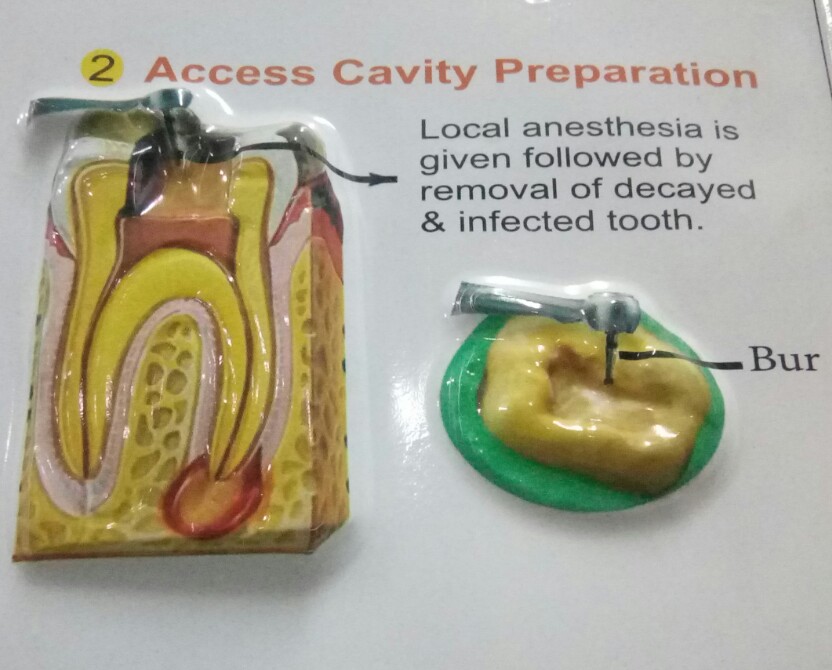
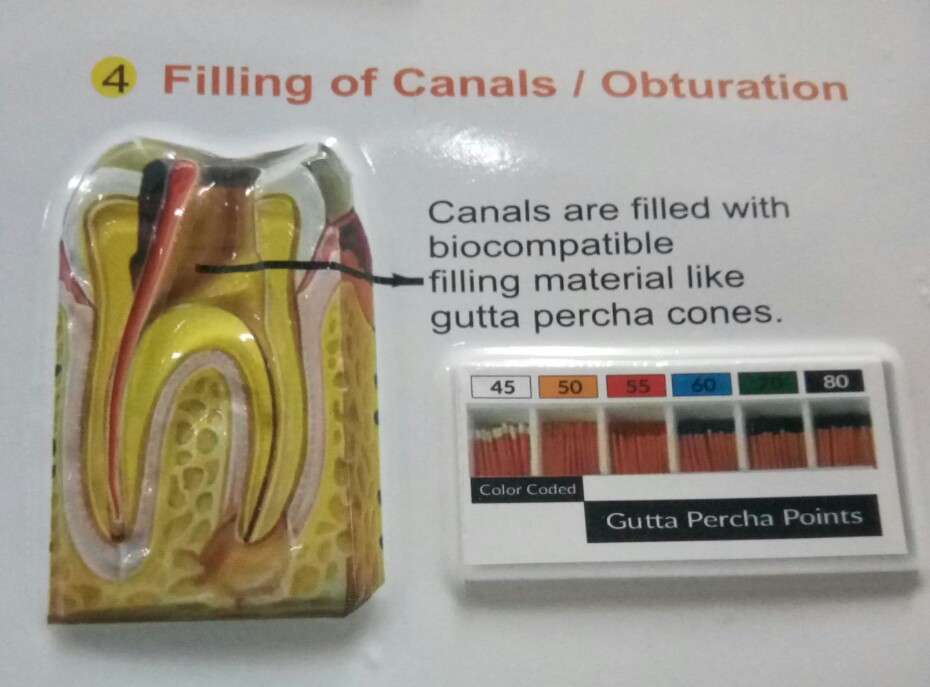
I am explaining the procedure, because being a patient even you have got all the rights to know the details about RCT. So, with the help of following images I hope you will be able to understand this treatment more easily.
Frequently Asked Questions by most patients
1.How many sittings/appointments are needed for a root canal?
>>Root canal treatment may take place in one sitting, but sometimes 2 or 3 appointments are needed and this generally depends on the severity of infection of the tooth.Each sitting may last between 30-90 minutes.
2.Is the procedure painful?
>>During the procedure you may feel a bit of pain and this is normal, otherwise its not a painful procedure because a local anesthesia is injected to numb the area and prevent teeth pain during the procedure.Sometimes your anxiety and fear becomes the reason of pain.
3.Should I brush my teeth after root canal?
>>Yes, you can brush and floss, treated tooth gently, but avoid flossing if the temporary filling was placed in the space between teeth.
**Dental floss is a cord of thin filaments & flossing is a procedure used to remove food debris and dental plaque from between teeth in areas a toothbrush is unable to reach.
4.What should I eat after root canal?
+Avoid chewing crunch or hard food after the treatment.
+Do not eat or drink for atleast one hour after the root canal.
+Limit your diet to soft foods.
+Have soft fruits like banana, mango, dairy products like yoghurt, milk, milkshakes, icecream, soft proteins like eggs, tofu fish, etc.
+Avoid eating sticky foods.
5.What is the cost of RCT in India?
>>Cost of RCT= Rs.2000.Approx.
>>Price of crown or cap= Rs(3000-4500).Approx.
Precautions to be taken after a root canal process:
1.Take pain relievers/killers if you feel pain.
2.Take antibiotics time to time as prescribed by your dentist.
3.If you are a smoker, then quit smoking.
4.Eat only after the numbness in your mouth wears off, otherwise you will bite/hurt your cheek or tongue.
5.Maintain oral hygiene by brushing & flossing daily.
6.After your root canal and any follow-up appointments are completed, then you have to visit your dentist once again for a final crown(cap) to fully restore the teeth.
7.Remember, if you experience pain or swelling in the future then be sure to return to your dentist.
Want to publish your article or other content on D1 Magazine ?
Get a FREE Membership on Sign Up and Go to Articles in your Profile Page. Become an Author Dentista.
Area of operation : lower right third molar with pain ,advised for extraction after confirming with radiographs.
Before I call it a crazy method , I haven’t explored much to assess how many skilled dentist would have tried this technique. And yet it’s not a profound technique nor more of a complex scenario.
Extraction of third molar has always been a bit complicated. We always know of it’s pros and cons in pre-evaluation radiographs . And atraumatic exodontia is always what every dentist is expected to perform. Imagine, if the supportive equipment went wrong and all you have to rely on is the the isolation and management in the old school way. Oh god, it gets gory real soon! There is real pool of blood , the tooth not visible and supporting tissue floating in the blood.
In this case, Our area of operation is on right third lower molar. The initial inferior alveolar block had been good success after the patient confirms of objective and subjective signs . Next, with the Bard Parker no.15, the real surgeon gets confronted for a moment to perform the incision confidently. Then I decide to drill around bone, surrounding the right third molar.
What we all need is to keep “focus” at area of operation to make sure nothing goes wrong or deviate from our plan. That same stubbornness of focus can help if things can’t be done precedent way. You will always find a way, trust me.
And I cut interradicular bone to luxate tooth, it went better enough to take out the mesial root. But distal one, real crux in this operation was awaiting with that bad gesture. When I tried to luxate with crossbar, I could hear some creaking sound with extracting distal 3/4. The rest is inside. Then I stopped , I paused for a while , and I realize the real crux is welcoming me . Being dicey, I tried with files to retrieve the root spicule , and it all went bad due to the blood and isolation was bad as the supportives. But my benevolent staffs , were real supportive angels through out my procedure, their incessant care and love to their duty helped to manage well than I expected. So now, it’s time, I have to show myself whether I have to give up on this distal part or try again. But am never a “ giving up ” guy.
After rationalizing for a moment , enough to think what I can try here, all learned technique have been failing me one by one , even though isolation performing were best driven by our nurses .
Then suddenly in a quick , I decide to keep the distal root back , why I can’t keep tooth back , come on guys . Why we have to pull the distal spicule with file alone ? What if I can keep distal root back to socket , then I can get guidance to distal spicule , (because on other side isolation is compromising ).
Bingo
I tried 30 no. file with much push stroke from access of tooth to apex manner. And with all forces I have got from my workouts, I have pulled back.
Awesome , I got root and distal stump with file in one go. Amen.
What I realized after that case is that, if we are not ready to give up, the right portals opens, that we will find it on our own. It’s just simple and easy as that. And I could see the happy patient smile after all we have been performing to get this tiny thing out of socket.
I am a dentist who live in a village where people and I do services with love and care. I am penning down this article to share an unforgettable real life incident that happened in my life.
One fine day after doing my usual consultations, I was having coffee in my clinic. A person suddenly came into my clinic. He was looking sad and panicked. He was breathing heavily. I asked him:
Sir, what is the matter?
He said his loving pet, an African Love Bird, accidentally got an aluminum ring stuck on its leg and it is in pain. I told him he should be seeing a veterinary doctor. He sat down and explained then, how a veterinary doctor had already tried and the risk of taking the ring without fracturing that poor bird’s legs is high. He then said that it was the Vet who advised to come and meet me. I asked him to get the bird, I was not sure what I’ll do, but I decided to help anyways.
He came back with the bird. The poor little thing was shivering with pain or maybe fear. The ring was very rigid and very close to the leg. It won’t be easy, I said to myself. I took out the orthodontic pliers and tried cutting the ring carefully. The ring was too strong, and I couldn’t use too much pressure.
Then suddenly is struck me, We cut the strongest substance in human body, enamel and even metal alloy crowns with our Airotors. I went and grabbed my Airotor hand piece, loaded a coarse straight bur and started cutting the ring from one side. I also slid in a plastic filling instrument beneath the ring to protect the bird’s leg from the bur. I took half an hour to carefully cut through the ring. The bird had a little wound from the tightly bound ring. I clean the ground with some surgical spirit and dressed it with some cotton and betadine solution. My heart was content. I was glad i took up this case.
After a little while, the bird started becoming active and tip toeing
around. The happiness in that man’s face made me feel I’m in a noble
profession. He asked how much is my fee and I gave him a smile. I gave a
little hug to the baby bird with my index finger. Some happiness cannot
be bought, it’s earned.
1 week later the man contacted me over
phone and told me that his bird and completely recovered. I smiled in
happiness and looked at my Mighty Hand Piece. A sudden light reflected
from the dental diamond bur, sparkling in my eyes.
Want to publish your article or other content on D1 Magazine ?
Get a FREE Membership on Sign Up and Go to Articles in your Profile Page. Become an Author Dentista.
Weddings mark the beginning of a new chapter in bride and the groom’s life. It holds a very special day in a girl’s life and she wants it to be nothing else but Perfect.
Apart from all the other arrangements from decor to the attire, the most important and memorable one is the pictures. We invest so much to get the best photographers. But are we picture ready?
Pictures play an important role in weddings & so does the smile.
Here are a few tips to get that pearly white picture perfect smile.
1. Check
Stand in front of the mirror & try to get the best posture & smile that you can admire.
Try tilting your face a bit to get that perfect angle. You can use your smartphone to take some selfies & get that perfect look.
Try to show 8 teeth to get that perfect smile.
If you find your teeth have become yellowish with age, visit your favorite dentist for teeth whitening. Get your teeth & gums checked for other flaws. These days white teeth and pink gums are easy to achieve with a basic laser procedure.
Other problems like chipped teeth or cavities can be cleared in a sitting or two.
2. Maintain
Now that you got your teeth cleaned & whitened, make sure that you do brushing twice & flossing to maintain those white pearls. You may take home whitening kits to enhance or get some touch up done before your big day.
Avoid taking colored food or drinks as that may again discolor your teeth. Too much of tea and coffee may cause darkening of the teeth.
Sip lots of water to keep them shiny and bright.
You may chew sugarless gums to increase the salivary flow which helps to keep your teeth hydrated.
3. Enhance
Be confident & natural when you smile. A confident smile looks more attractive & appealing.
Smile with your eyes.
Ladies, don’t forget to use a dark lip shade as it makes teeth look whiter & brighter.
You can glam up your smile by adding a sparkling dental jewel, matching with your attire. These Swarovski crystals can easily be placed on the teeth without any pain or effecting the integrity of the teeth.
And don’t forget, it takes just seventeen muscles to smile while 43 to frown. So leave the stress and keep that Smile On.
Want to publish your article or other content on D1 Magazine ?
Get a FREE Membership on Sign Up and Go to Articles in your Profile Page. Become an Author Dentista.
Preparing for GCC Exams is a very confusing process. It is hard to get the right guidance from anywhere. We formed our Jobhunters GCC WhatsApp grps in that intension.
Acquiring an employment in GCC is a cumbersome task. There are a lot of hurdles to overcome to become a licensed Dentist in the Middle East. Two of the common and most important deciding factors of selection in any interview here is, Previous Middle East Work Experience and Proficiency of the Local Language.
.gif)